

 | ||
|
| ||
News |


|
| Custom Silicone Anti-slip Elastic: OEM Customization & RFQ Preparation Guide for Apparel Brands | |||||||||||||||||||||||||||||||||||
2026-07-07 17:03:33 | |||||||||||||||||||||||||||||||||||
Buyer Guide SeriesIf you're evaluating silicone anti-slip elastic for your next apparel project, this series walks you through each stage of the purchasing decision. Step 1. What Is Silicone Anti-slip Elastic? Applications, Benefits and Buying Guide Step 2. How Silicone Anti-slip Elastic Improves Garment Performance Step 3. Silicone Printing vs. Woven Grip Elastic: Which Anti-slip Solution Is Best? Step 4. How to Choose the Right Silicone Grip Pattern for Different Garments Step 5. Custom Silicone Anti-slip Elastic: OEM Customization & RFQ Preparation (Current Guide) Next: MOQ, Sampling, Lead Time & Production Process From Product Selection to OEM DevelopmentAfter comparing anti-slip solutions and selecting an appropriate silicone grip pattern, the next step is turning your concept into a manufacturable product. For apparel brands, garment manufacturers, sourcing teams, and product developers, ordering custom silicone anti-slip elastic involves much more than choosing a width or color. The quality of the information provided during the inquiry stage directly affects quotation accuracy, sample development, production efficiency, and delivery schedules. Incomplete RFQ information often leads to repeated communication, longer sampling cycles, and unnecessary revisions. By contrast, a well-prepared specification allows manufacturers to evaluate feasibility quickly, recommend suitable production methods, and provide more accurate pricing. This guide explains what can be customized, what information manufacturers need before sampling, and how buyers can prepare an efficient RFQ that shortens development time while reducing project risk. Why More Apparel Brands Choose OEM Silicone Anti-slip ElasticMany performance garments require functions that standard elastic cannot provide. Different products demand different grip strength, elasticity, comfort, branding, and washing durability. Sportswear may require stronger grip during movement, while underwear focuses on comfort and flexibility. Compression garments often need consistent support without creating pressure points. Because of these differences, many apparel brands prefer customized silicone anti-slip elastic rather than standard stock materials. OEM development allows buyers to optimize product performance while maintaining a consistent brand identity across multiple product lines. Typical customization projects include:
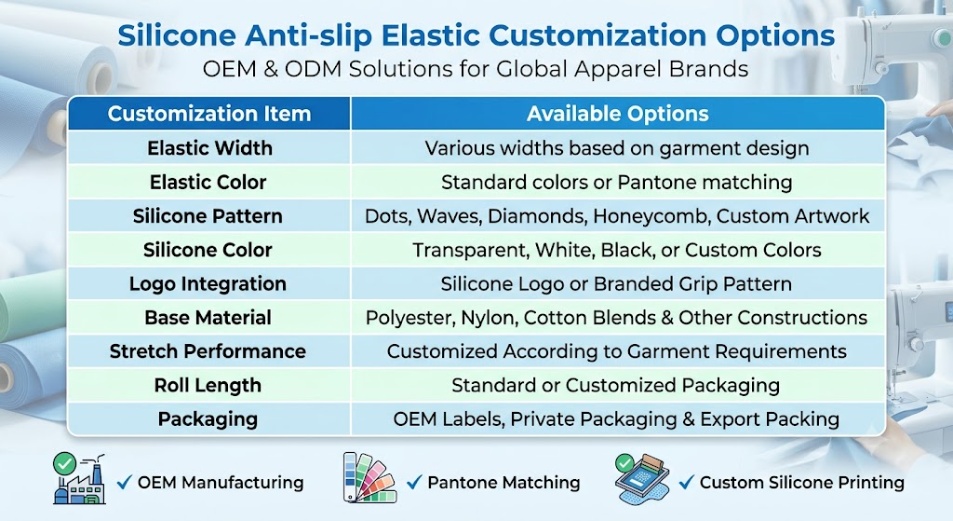
What Can Be Customized?The following elements can typically be customized to meet different apparel applications.
How OEM Silicone Patterns Are DevelopedCustom silicone patterns are generally developed through a structured process rather than being produced directly from artwork. A typical development workflow includes:
During development, manufacturers evaluate not only the appearance of the silicone pattern but also its grip performance, adhesion, flexibility, wash durability, and production consistency. Early technical communication helps reduce design revisions and shortens overall development time. OEM Design ConsiderationsBefore requesting a quotation, define the key technical requirements to help manufacturers recommend suitable solutions and prepare accurate pricing. The most important considerations include:
Providing this information early helps reduce sampling revisions and speeds up product development. RFQ Preparation ChecklistA complete RFQ allows manufacturers to evaluate projects more efficiently.
A well-prepared RFQ improves quotation accuracy and shortens communication time. Information That Helps Manufacturers Quote FasterThe more complete the project information, the faster manufacturers can evaluate production feasibility.
Clear specifications help reduce unnecessary revisions during sampling. Common RFQ MistakesAvoid these common issues before submitting an inquiry:
Providing complete information allows manufacturers to recommend more suitable production solutions from the beginning. Frequently Asked Questions
Can silicone patterns be customized?
Can logos be incorporated into silicone printing?
Is sampling recommended before mass production? ConclusionSuccessful OEM projects begin with clear communication and complete RFQ information. By defining your technical requirements early, manufacturers can recommend suitable production solutions, improve quotation accuracy, and shorten sampling time. In the next guide, we'll explain MOQ, sampling procedures, production lead times, and manufacturing workflows to help buyers plan production more efficiently. |
 |
Fu Jyi Lin Enterprise Co., Ltd. Copyright © 2014 |
| Address: 10071 No.17-1, SHAU ANN St., Zhongzheng Dist., Taipei City 100, Taiwan (R.O.C.)
TEL:886-2-2301-5900 , 886-2-2307-0952 FAX:886-2-2307-5424 , 886-2-2332-6930 E-Mail:info@fujyilin.com.tw |