

 | ||
|
| ||


Webbing & Tape
Product Name : Heavyweight Cotton Webbing
| Description |
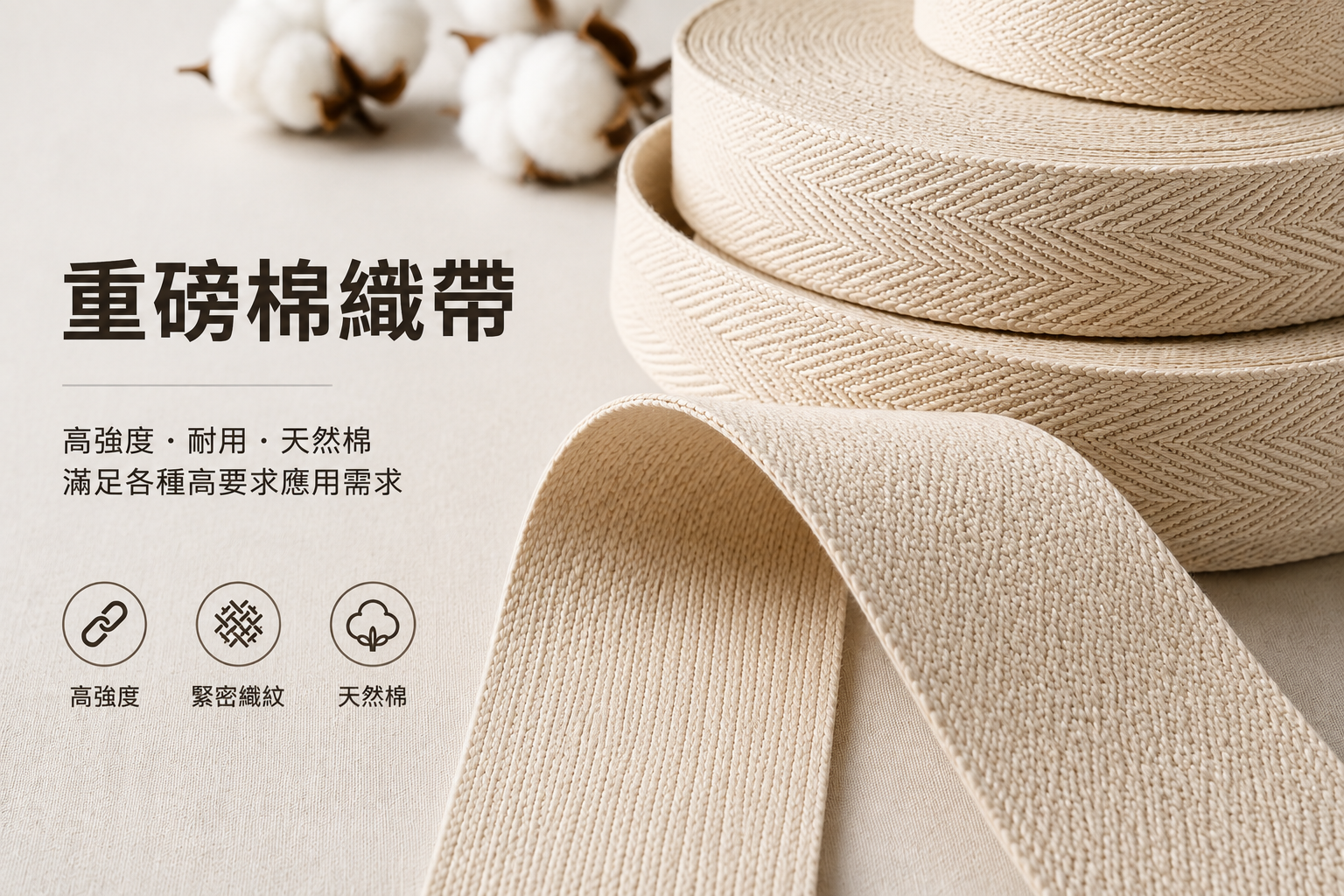
| Heavyweight cotton webbing is made with heavier cotton yarn configurations and dense woven constructions to create a thicker, more substantial structure while retaining the natural appearance and hand feel of cotton. It is suitable for canvas bags, tote handles, backpack straps, belts, workwear accessories, upholstery, outdoor products, pet accessories, and other sewn or assembled components requiring a heavier webbing construction. Different widths, thicknesses, yarn configurations, weave patterns, and constructions can be developed according to product requirements. Available options may include plain, twill, herringbone, and ribbed weaves, as well as flat, tubular, or double-layer constructions. Color matching, jacquard, printing, cutting, folding, punching, sewing, X-box reinforcement, and hardware assembly can also be evaluated. Pre-shrinking, softening, water-repellent, and other functional finishing options are available depending on the material and intended application. Fu Jyi Lin supports OEM and custom heavyweight cotton webbing development from specification review and sampling through converting and production. Customers may provide physical samples, drawings, artwork, hardware specifications, assembly details, hand-feel requirements, or intended applications to help determine suitable materials, yarn configurations, constructions, and processing methods for finished or semi-finished webbing components. |
 Specification
 |
|
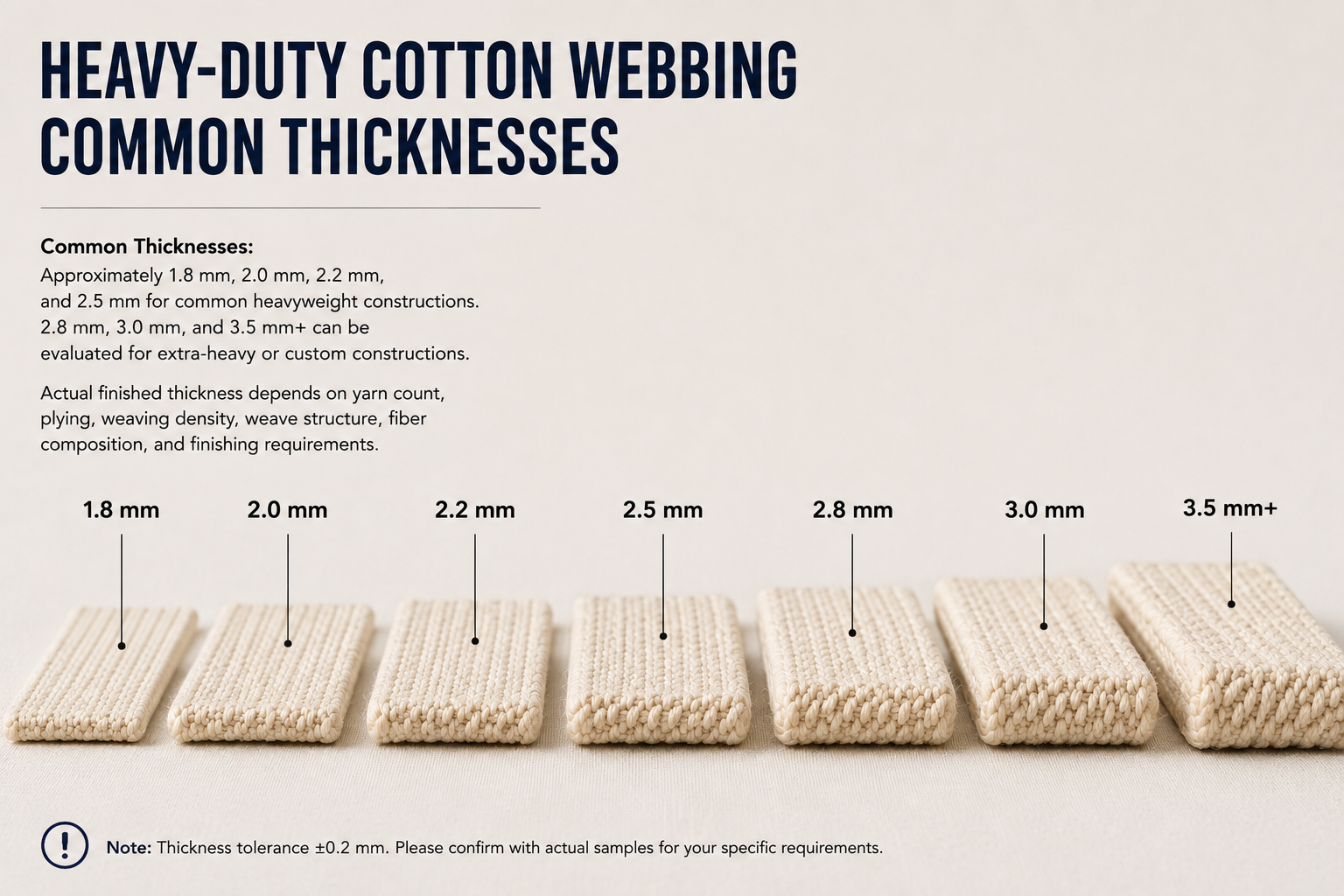
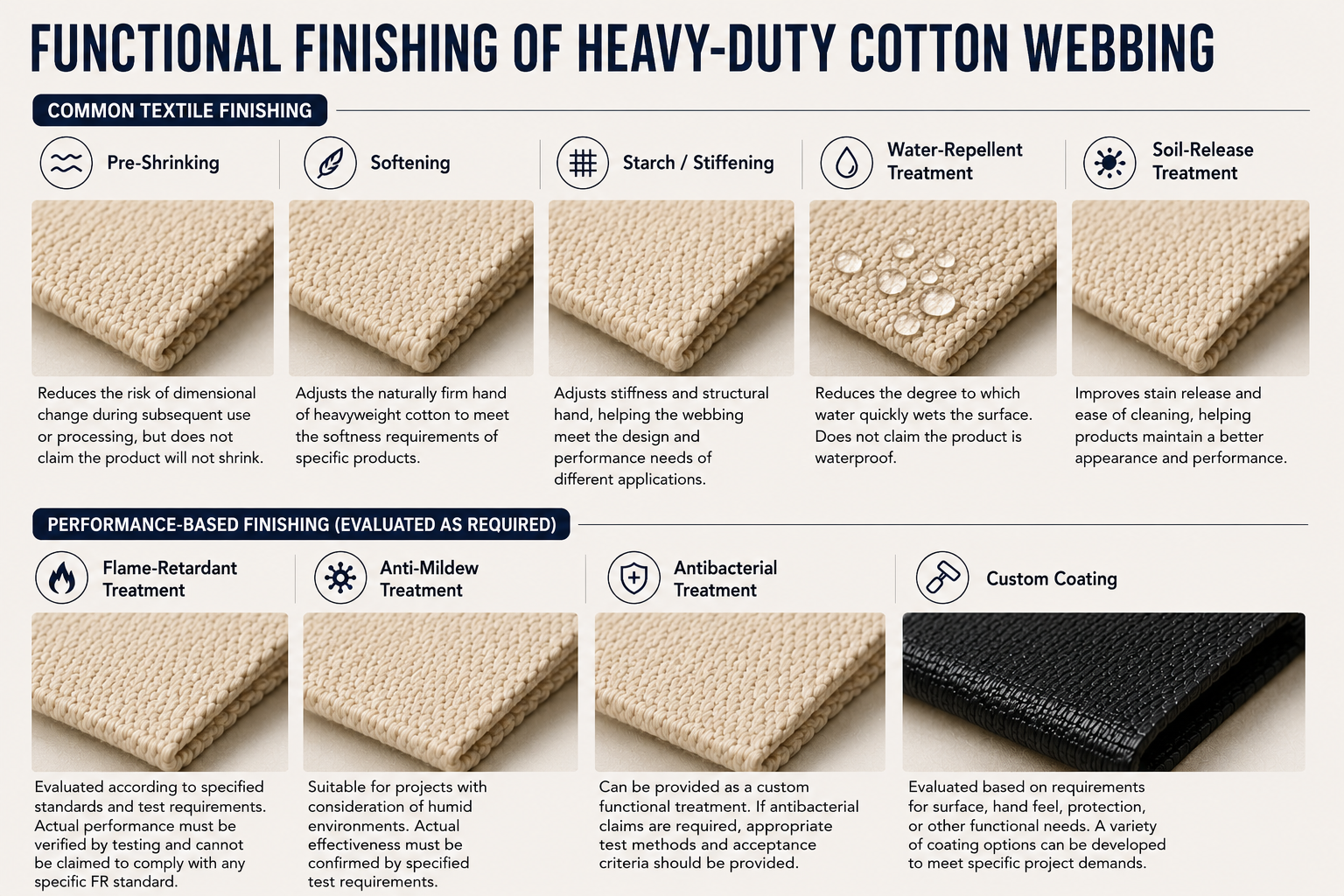
**Product Name:** Heavyweight Cotton Webbing **Material:** Primarily 100% cotton. Polyester/cotton blends (T/C) may also be evaluated depending on the required construction, hand feel, dimensional stability, dyeing method, finishing process, and end-use application. **Common Widths:** 12 mm (1/2"), 16 mm (5/8"), 20 mm (approximately 3/4"), 25 mm (1"), 32 mm (1.25"), 38 mm (1.5"), and 50 mm (2"). Among these, 25 mm, 38 mm, and 50 mm are commonly used for heavier webbing applications. Wider constructions such as 75 mm (3") and 100 mm (4"), as well as other non-standard widths, can be developed according to product and assembly requirements. **Common Thickness:** Approximately 1.8–2.5 mm for common heavyweight constructions. Actual thickness varies depending on yarn count, plying, weave structure, and weaving density. **Extra Heavy / Custom Thickness:** Approximately 2.8–3.5 mm or other specified thicknesses can be evaluated for products requiring a thicker, firmer, or higher-density construction. Feasibility depends on width, yarn configuration, weave structure, and production requirements. **Common Yarn Count & Plying:** Heavyweight cotton webbing commonly uses coarser cotton yarns and plied-yarn constructions to develop a more substantial structure. Common references include 10s and 20s cotton yarns with 2- to 4-ply configurations, such as 10s/2, 10s/3, 10s/4, 20s/2, and 20s/4. Yarn count and plying are not fixed specifications. They should be selected according to webbing width, thickness, warp and weft configuration, weaving density, required hand feel, performance requirements, and intended application. **Construction Options:** Flat Webbing, Tubular Webbing, Double-Layer Construction, and other custom high-density constructions. The appropriate structure can be selected according to required thickness, flexibility, firmness, hardware compatibility, and assembly method. **Weave Options:** Heavy-Duty Plain Weave, Heavy Twill, Herringbone Weave, Ribbed Weave, and other custom patterns. Different weave structures affect surface texture, thickness, flexibility, firmness, density, and overall hand feel. **Color Options:** Common basic colors include Natural, White, and Black. Other colors can be custom matched according to a specified Pantone reference. Olive, Khaki/Tan, Navy, and similar colors are also commonly used for workwear, bags, and outdoor-style products, subject to project requirements and production conditions. **Dyeing Options:** Yarn-dyed and piece-dyed processes can be evaluated depending on the fiber composition, yarn, construction, color requirements, and order conditions. Color appearance and colorfastness may vary according to fiber composition, dyestuff, dyeing process, and finishing conditions. Specified colorfastness requirements should be provided during development. **Jacquard Design:** Custom jacquard webbing can be evaluated for logos, lettering, patterns, and brand identification. Feasibility depends on webbing width, thickness, yarn configuration, weave construction, and artwork complexity. **Printing Options:** Screen printing and other suitable printing methods can be evaluated according to the webbing surface, artwork, colors, and finished-product requirements. **Basic Converting:** Available converting options may include cut-to-length processing, folding, punching, ironing, sewing, X-Box reinforcement stitching, riveting, and metal or plastic hardware assembly. Because 100% cotton does not provide the same heat-sealing characteristics as thermoplastic synthetic fibers, cut ends may require sewing, folding, binding, or other suitable edge-finishing methods depending on the webbing construction and final assembly. **Functional Finishing:** Depending on the intended application, available finishing options may include pre-shrinking, softening, water-repellent treatment, soil-release treatment, flame-retardant treatment, anti-mildew or antibacterial treatment, custom coating, and other functional finishes. The suitability and resulting performance of each treatment depend on the fiber composition, webbing construction, dyeing process, finishing conditions, and applicable test method. Projects with specified performance requirements should provide the target standard, test method, or acceptance criteria for evaluation. **Applications:** Heavyweight cotton webbing is commonly used for canvas and tote bag handles, backpack shoulder straps, duffel bags, belts, workwear accessories, upholstery webbing, outdoor products, pet collars and leash components, tool bags, equipment edging, and other sewn or assembled products requiring a thicker or higher-density textile webbing structure. Applications involving specified load-bearing, safety, industrial, or regulatory requirements should be evaluated according to the final product, required performance, and applicable testing standards. **Standard Roll Packing:** Roll packing can be arranged according to webbing width, thickness, unit weight, and order requirements. Because heavyweight constructions can vary considerably in weight and bulk, roll length should be confirmed according to the final product specification. **Custom Packaging:** Custom roll lengths, cut lengths, individual packing, small packs, or other packaging formats can be evaluated according to shipping, assembly, retail, or project requirements. **Minimum Order Quantity (MOQ):** MOQ is determined by material, width, thickness, color, weave construction, dyeing method, and secondary processing requirements. Natural or existing specifications may allow lower production quantities, while custom dyeing, special thicknesses, high-density constructions, and functional finishing may require different minimum production quantities. **OEM / ODM Services:** Custom development is available for material, width, thickness, yarn configuration, weave, color, jacquard, printing, converting, functional finishing, and packaging. Customers may provide physical samples, technical drawings, artwork, hardware specifications, assembly details, required hand feel, or end-use requirements for specification evaluation, sampling, and production planning. ## Specification Notes The widths, thicknesses, yarn counts, plying configurations, constructions, and weave options listed above are based on commonly available Heavyweight Cotton Webbing specifications and practical webbing manufacturing considerations. They are intended as references for product development and quotation preparation rather than fixed specifications applicable to every heavyweight cotton webbing product. Other dimensions, thicknesses, yarn configurations, and constructions can be developed for OEM/ODM projects. There is no single universal thickness that defines Heavyweight Cotton Webbing. Finished thickness, firmness, hand feel, and performance are influenced by fiber composition, yarn count, number of plies, warp and weft configuration, weaving density, weave structure, width, and finishing process. Thickness or yarn count alone should therefore not be used to determine the performance of the finished webbing. Natural cotton and polyester/cotton blends may differ in dyeing behavior, shrinkage, hand feel, and finishing performance. Custom-dyed products may also show reasonable color variation between approved samples and production lots due to fiber, yarn, dye-lot, and processing conditions. For projects requiring specified tensile strength, abrasion resistance, shrinkage, water repellency, flame retardancy, anti-mildew, antibacterial performance, or other functional properties, customers should provide the applicable test method, target value, or acceptance criteria during quotation or sample development. Final testing should be conducted by the customer according to the intended end use or through a designated third-party testing laboratory. |
|
Asks Description |
|
Frequently Asked Questions (FAQ) 1. What information should I provide for an accurate quotation? Please provide the required width, thickness, color, weave, quantity, intended application, and processing requirements. Physical samples, drawings, artwork, or assembly details are also helpful for custom projects. If specific performance is required, please include the applicable test method or acceptance criteria so the construction and quotation can be evaluated accordingly. 2. What products commonly use Heavyweight Cotton Webbing? Heavyweight Cotton Webbing is commonly used for canvas and tote bag handles, backpack straps, belts, workwear accessories, upholstery, outdoor products, pet accessories, and tool bags. Its thicker, more substantial construction makes it suitable for brands and manufacturers seeking a natural cotton appearance combined with a firmer textile structure for sewn or assembled products. 3. How does cotton compare with polyester, nylon, and PP webbing? Cotton provides a natural appearance and textile hand feel. Polyester offers low moisture absorption and good dimensional stability; nylon provides flexibility and abrasion resistance; PP is lightweight with low moisture absorption and resistance to many common chemicals. The appropriate material should be selected according to application, environment, appearance, hand feel, and required performance. 4. How does Heavyweight Cotton Webbing differ from standard Cotton Webbing? Standard Cotton Webbing is suitable for general straps, trims, handles, and sewn applications. Heavyweight Cotton Webbing typically uses coarser yarns, plied yarns, or higher weaving density to create a thicker and firmer structure. Selection should consider the required thickness, hand feel, hardware compatibility, sewing method, and intended application rather than thickness alone. 5. What customization and converting options are available? Custom options include width, thickness, weave, construction, and color, with additional processing such as jacquard, printing, cutting, folding, punching, sewing, reinforcement stitching, and hardware assembly. Pre-shrinking, softening, water-repellent, flame-retardant, or other functional finishes can also be evaluated according to the material, end use, and specified performance requirements. |
|
Other |
|
|
 |
Fu Jyi Lin Enterprise Co., Ltd. Copyright © 2014 |
| Address: 10071 No.17-1, SHAU ANN St., Zhongzheng Dist., Taipei City 100, Taiwan (R.O.C.)
TEL:886-2-2301-5900 , 886-2-2307-0952 FAX:886-2-2307-5424 , 886-2-2332-6930 E-Mail:info@fujyilin.com.tw |