


 | ||
|
| ||
News |


|
| Wearable Device Straps: Balancing Grip, Comfort and Adjustability | |
2026-10-16 14:04:52 | |
**Wearable Device Straps: Balancing Grip, Comfort and Adjustability**
## Designing Around Real Wearing Conditions
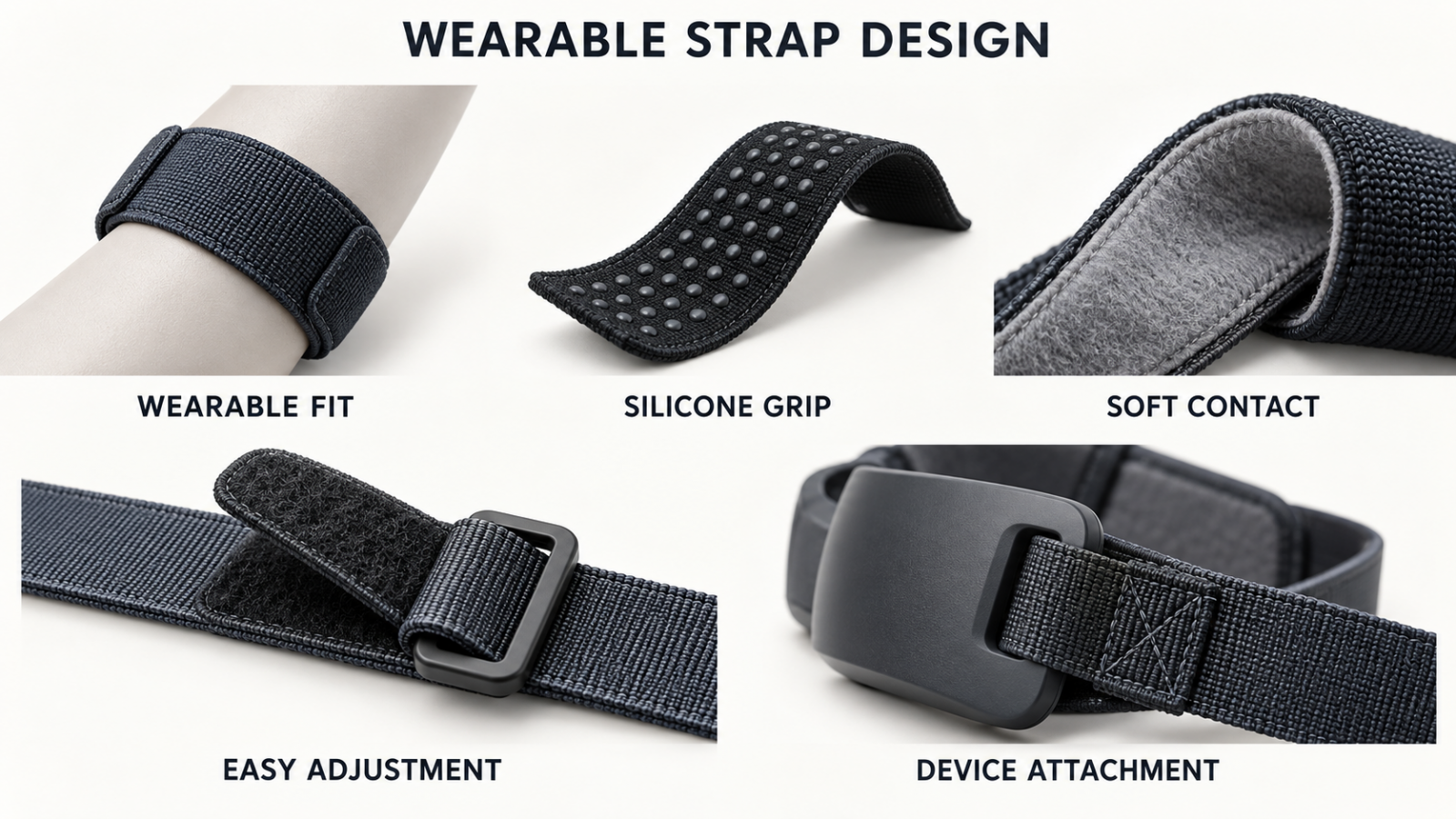
With MEDICA 2026 taking place in Düsseldorf, Germany, on November 16–19, Fujyilin is highlighting the textile components that connect wearable and rehabilitation equipment to the user. For arm straps, leg supports and waist attachments, development starts with three practical questions: will the strap stay in position, feel comfortable and allow convenient adjustment? The answers depend on how the complete device is worn. Before selecting materials or finishes, define the body location, wearing duration, movement and contact surface. A strap positioned over clothing should be evaluated with that fabric, while a design intended for direct skin contact requires its own material and contact requirements.
## Matching Silicone Grip to the Contact Surface
Silicone grip treatment can be explored when a strap needs additional resistance to movement against its contact surface. The development brief should identify the treatment side, coverage area and intended grip location. Dot, line or other patterns can then be compared through samples. The aim is to find a suitable combination of grip, flexibility and contact feel for the application. More silicone coverage should not automatically become the preferred specification. For example, a leg strap worn over a sleeve should be assessed with the intended sleeve material and device arrangement. Recording these conditions makes feedback more useful when refining the next sample.
## Considering Comfort Across the Finished Assembly
Comfort involves the whole strap assembly, including the base material, edges, seams, folded ends and hardware. A soft webbing or elastic sample is a starting point; the finished construction also needs review. Check where the strap bends, where stitching meets the wearer and whether exposed hook surfaces or buckle edges create unwanted contact during movement. Depending on the design, possible adjustments may include repositioning a seam, changing the edge finish or evaluating a lining. For direct skin contact, communicate the location, duration and required material evaluations early. Final suitability should be assessed as part of the complete device and its intended use.
## Making Adjustment and Removal Easier
An adjustable strap should accommodate the intended fitting range and the way it will be operated. Define the smallest and largest fit, the usable hook-and-loop fastening area and the direction of pull. Consider whether the wearer will adjust the strap independently or receive assistance from a caregiver. During sample review, check whether the strap end is easy to locate and grasp, whether it passes through the buckle as intended and where excess length sits after fastening. Elastic sections, closure positions and attachment points should be reviewed together. Putting on, adjusting and removing the device provides a more complete picture than testing an unattached strap.
## Reviewing the Strap on the Actual Device
Once the main construction is selected, install the sample on the device or a representative fixture. Review its position during the intended movements, the contact areas and the operation of each closure. Use consistent fitting conditions when comparing alternatives so that observations can be linked to specific design changes. Feedback should identify where movement or unwanted contact occurs, rather than simply requesting a tighter or softer strap. When cleaning and repeated use are relevant, the device manufacturer should define the evaluation conditions and acceptance requirements. This application review helps the development team decide which features to retain and which require further adjustment.
## Connecting Material Selection with Custom Strap Development
Fujyilin supports custom webbing, elastic, hook-and-loop and sewn strap assemblies, with cutting, silicone grip treatment and hardware integration evaluated according to project requirements. Bringing these elements into one development discussion helps buyers describe the complete strap they need. To begin, share an application photograph, drawing or reference sample, together with the wearing position, adjustment range and expected quantities. Identify any fixed components and the areas where alternative constructions can be considered. As manufacturers prepare for MEDICA 2026, Fujyilin welcomes discussions on textile strap requirements for wearable and rehabilitation equipment, helping connect material choices and processing details with a clearly defined assembly brief.
|
 |
Fu Jyi Lin Enterprise Co., Ltd. Copyright © 2014 |
| Address: 10071 No.17-1, SHAU ANN St., Zhongzheng Dist., Taipei City 100, Taiwan (R.O.C.)
TEL:886-2-2301-5900 , 886-2-2307-0952 FAX:886-2-2307-5424 , 886-2-2332-6930 E-Mail:info@fujyilin.com.tw |