


 | ||
|
| ||
News |


|
| Custom Strap Assembly: From Cutting and Silicone Grip to Sewing | |
2026-10-15 18:16:58 | |
**Custom Strap Assembly: From Cutting and Silicone Grip to Sewing**
For wearable equipment, rehabilitation supports, and other adjustable products, a strap is more than a length of webbing. Its finished performance depends on how the material is cut, treated, fastened, and sewn. Buyers therefore need to evaluate these steps as one development process rather than separate services. Ahead of MEDICA 2026 in Düsseldorf, November 16–19, Fujyilin highlights six practical considerations for custom textile strap projects.
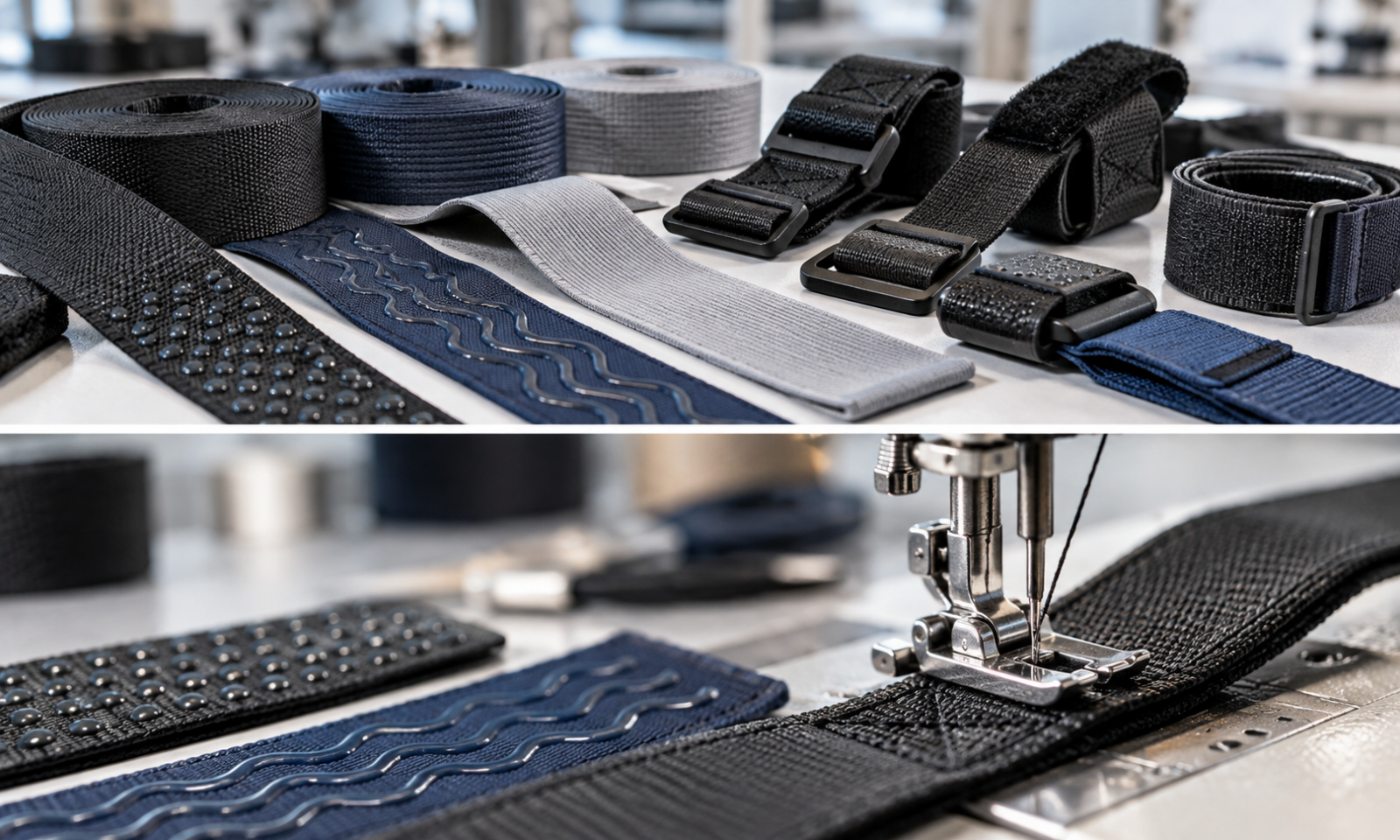
1. Define the Finished Strap Requirements
Development should begin with the intended application. Will the strap hold a component in position, adjust around the body, or stretch during movement? These questions influence material selection and construction.
Polyester or nylon webbing may suit applications requiring dimensional stability, while elastic materials can provide controlled stretch and recovery. Hook-and-loop fasteners, buckles, and other hardware should be considered at the same stage.
Buyers should also specify width, finished length, expected loading, contact surfaces, and any relevant comfort or cleaning requirements. The final combination must be evaluated against the actual product design.
2. Plan Cutting and Edge Finishing
Accurate cutting supports consistent lengths and more predictable assembly. Depending on the material, heat cutting or ultrasonic cutting may help seal the edges of suitable synthetic webbing and limit fraying. However, excessive heat can create stiff edges or affect appearance.
Elastic components require particular care: a measurement taken under tension may differ from the relaxed finished length.
Drawings should identify dimensional tolerances, edge requirements, and locations for later folding or stitching. A clean cut is valuable only when it also supports the next manufacturing step.
3. Match Silicone Grip to the Application
Silicone dots, lines, or customized patterns can increase friction in selected contact areas and help reduce unwanted movement. More grip is not necessarily better. Pattern placement must consider flexibility, comfort, and the surface the strap contacts.
For elastic straps, silicone formulation and curing conditions should be assessed for adhesion and compatibility with repeated stretching.
Buyers should also identify areas that must remain uncoated for sewing or fastening. Grip, wash resistance, and durability should be verified using agreed test conditions; silicone printing alone does not establish medical-grade or certified performance.
4. Coordinate Sewing and Component Assembly
Sewing brings the selected materials and fastening elements into a usable component. Common operations include folded-end stitching, hook-and-loop attachment, elastic-to-webbing joining, and buckle installation.
Stitch pattern, thread, seam placement, and reinforcement should reflect the anticipated load and adjustment cycle.
Poorly positioned seams can add bulk or restrict stretch, while stitching through a silicone-coated area may complicate production.
Reviewing a complete assembly drawing helps identify these issues before sampling. The goal is a strap whose materials, fastening method, and sewn construction function together.
5. Confirm Processing Sequence Through Samples
There is no single processing sequence for every design. One project may require silicone printing on continuous material before cutting; another may call for cutting and component preparation before sewing.
The chosen sequence should account for equipment, coating locations, tolerances, and handling.
Prototype evaluation can then check finished dimensions, edge quality, grip adhesion, stretch recovery, stitching integrity, and fastening function.
For medical-related applications, any additional safety, regulatory, or device-level validation remains the responsibility of the finished-product manufacturer and must follow its applicable requirements.
6. Prepare a Clear RFQ and Develop with Fujyilin
A useful request for quotation includes the strap's application, material preference, width, thickness, finished length, cutting and silicone requirements, stitch details, hardware, quantity, and target delivery schedule.
Technical drawings or physical reference samples are especially helpful when several processing steps must align.
Fujyilin supports B2B customers with webbing, elastic, hook-and-loop materials, cutting, silicone grip processing, sewing, and customized strap assembly.
By reviewing material selection and processing feasibility together, we help buyers move from an initial concept toward a sample suitable for evaluation and production planning.
As MEDICA 2026 brings attention to wearable and rehabilitation technologies, coordinated textile processing can make a meaningful difference in component development.
**Share your drawings, samples, or performance requirements with Fujyilin to discuss a practical OEM solution.**
|
 |
Fu Jyi Lin Enterprise Co., Ltd. Copyright © 2014 |
| Address: 10071 No.17-1, SHAU ANN St., Zhongzheng Dist., Taipei City 100, Taiwan (R.O.C.)
TEL:886-2-2301-5900 , 886-2-2307-0952 FAX:886-2-2307-5424 , 886-2-2332-6930 E-Mail:info@fujyilin.com.tw |